
 Invictus Academic Team
What is Friction? Friction: Definition and Meaning
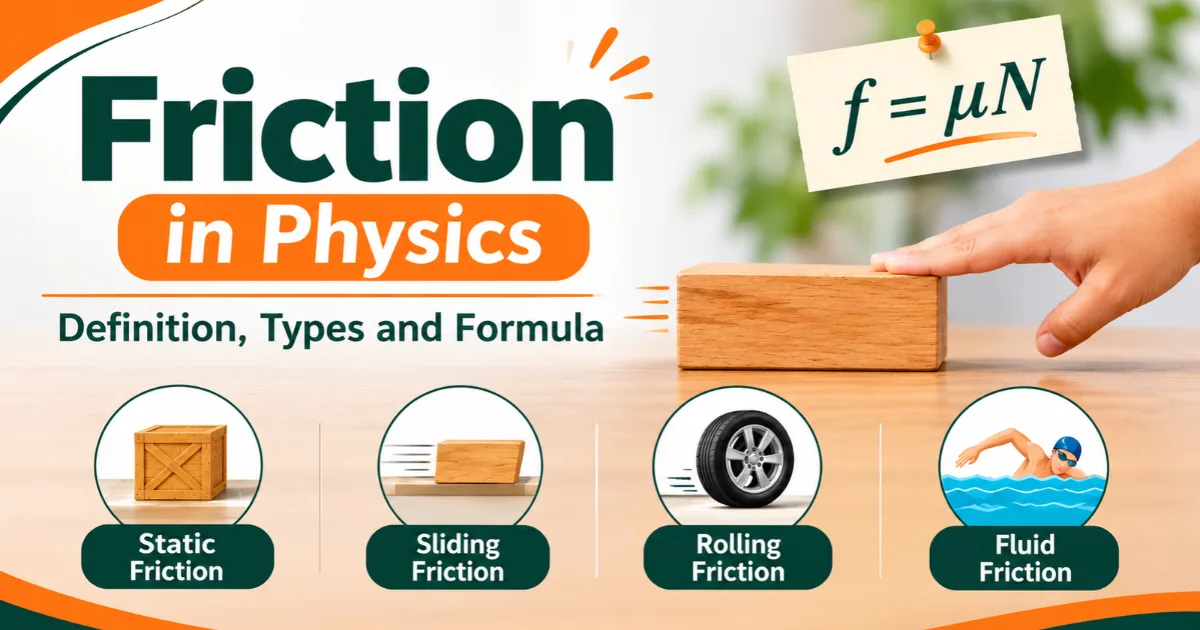
Friction definition (physics): Friction is the resistive force that acts along the surfaces of two bodies in contact and opposes their relative motion or their tendency to move.
What is meant by friction in simple terms?
Whenever you push a book across a desk and it slows down, friction is the reason.
Frictional force definition: the frictional force is the actual force, measured in newtons, exerted by one surface on the other, parallel to the contact surface. When someone asks what the definition of frictional force is or to define frictional force, this is the answer. It is a contact force and a self-adjusting force: it grows to match the applied push, up to a maximum value.
What Causes Friction? (Cause of Friction)
Even a smooth table looks rough under a strong microscope. It has tiny bumps and dips.
Two things cause friction:
- Interlocking: the bumps of one surface get stuck in the dips of the other, so sliding is hard.
- Sticking: where the surfaces touch, their atoms attract each other and make tiny temporary bonds, which have to be broken for the object to slide.
So friction is caused by these two things together. This is the cause of friction between two surfaces. Rubbing also produces heat, wear, and sound. Rubbing some materials (like a comb and hair) can also create static charge. This is called frictional electricity.
Factors Affecting Friction (What Friction Depends On)
The factors affecting friction are simple:
- Type of surfaces: rough surfaces have more friction, smooth surfaces have less.
- How hard the surfaces are pressed together: a heavier object has more friction. So the friction force depends on the weight pressing down (the normal reaction).
- Lubricant: oil or grease between surfaces reduces friction.
The magnitude of friction is independent of the area of contact (for solid surfaces). Pushing a brick on its wide side or its narrow side gives about the same friction. For fluid friction, the factors are the speed of the object, its shape, and how thick (viscous) the fluid is.
Friction Formula, SI Unit and Coefficient of Friction
f = μN
Here f is the force of friction, N is the normal reaction (on flat ground N = mg), and μ is the coefficient of friction. μ is a Greek letter read as “mu.” This is the friction equation. To calculate frictional force or find frictional force: first find N, then pick the right μ, then multiply.
- Static friction formula: fs ≤ μsN (friction is at most μsN)
- Limiting friction formula: fL = μsN
- Kinetic friction formula: fk = μkN
- Coefficient of friction formula: μ = f / N (use fL for static and fk for kinetic)
SI Unit and Dimensions of Friction
- SI unit of friction: Newton (N), since friction is a force.
- Dimension of friction:[MLT⁻²]
What kind of force is friction?
It is a contact force and a resistive force (the resistive force formula for solids is also f = μN).
Types of Friction (Types of Frictional Force)
Students often ask what the types of friction are or how many types of friction are there. The usual answer is four types of friction: static, sliding, rolling, and fluid. Some books say two types of friction (static and kinetic) or three types of friction (static, sliding and rolling). Kinetic friction means friction while moving, and includes sliding and rolling.
1. Static Friction (Static Force)
Static friction definition: the friction that acts on an object that is not moving and stops it from starting to move. When you search for what static force is or define static force, this is what it means.
Static friction examples (5 examples of static friction)
- A book resting on a tilted table
- A parked car on a slope
- A nail held in a wall
- You standing on the floor without slipping
- A ladder leaning on a wall.
2. Limiting Friction (and Impending Motion)
What is limiting friction?
Imagine you push a heavy cupboard. At first it does not move. Friction holds it in place. If you push harder, friction also gets bigger. But friction can only grow up to a limit. That biggest value of friction is called limiting friction.
Define limiting friction: limiting friction is the maximum friction that holds an object at rest, just before it starts to move.
What is impending motion?
It is the moment when the object is just about to move, but has not moved yet.
Limiting friction example: pushing a heavy cupboard until it just starts to slide.
Limiting friction formula: f = μ × N. Here μ is the coefficient of friction, and N is the force pressing the object down (its weight on flat ground).
3. Sliding Friction (Kinetic Friction, Dynamic Friction)
What is sliding friction?
When an object is already sliding over a surface, the friction acting on it is called sliding friction.
Sliding friction definition: the friction that acts when one surface slides over another surface.
Sliding friction is also called kinetic friction or dynamic friction. What is dynamic friction? It is the same thing as sliding friction. “Kinetic” and “dynamic” both mean “in motion”.
Kinetic friction formula: f = μ × N, where μ is the coefficient of kinetic friction.
Examples of sliding friction (kinetic friction examples): a box dragged on the floor, a sled on snow, a child on a slide, sandpaper rubbing on wood, a car skidding when the brakes lock.
4. Rolling Friction
Rolling friction is a type of friction that acts when a wheel or ball rolls on a surface. It is much smaller than sliding friction. This is because a rolling wheel does not drag. It just keeps turning.
Examples of rolling friction (5 examples of rolling friction):
- A bicycle wheel
- A football rolling on grass
- Ball bearings
- Car tyres
- A suitcase with wheels.
5. Fluid Friction
What is fluid friction?
Liquids and gases are called fluids. When an object moves through water or air, the fluid pushes back against it. This resisting force is fluid friction.
Fluid friction definition:
The force that a liquid or gas applies on an object moving through it. The friction force exerted by fluids is called fluid friction. Fluid friction is also known as drag or fluid resistance.
Fluid friction examples:
- A swimmer in water
- A parachute in air
- A boat on a lake
- A ball falling in oil.
Difference between viscosity and friction: viscosity means how thick a fluid is, for example honey is more viscous than water. Ordinary friction happens between two solid surfaces.
Friction as a Friend and a Foe
Friction is important because it gives us grip. Without it, we could not walk, hold a glass, write with a pencil, tie a knot or light a matchstick. A bicycle or a car could not stop, because the brakes work only through friction. This is why friction is necessary, and it is why friction is called a friend.
Friction is also used a lot in sports. Studded shoes grip the ground so players don’t slip, and the rough grip on a cricket bat or tennis racket keeps it from sliding out of the hand. Other uses of frictional force are fixing nails and screws in wood, and sprinkling sand on a slippery road.
But friction can also be a foe. When parts of a machine rub against each other, they slowly wear out, get hot and make noise. Energy and fuel are wasted in overcoming friction. You can see these effects of friction in worn-out shoe soles, hot engine parts and grinding gears. These are good examples to show that friction is a foe.
How to Increase and Reduce Friction
Sometimes we need more friction. To increase friction, we can make surfaces rougher, as in tyre treads and grooved shoe soles, or press the surfaces together harder. Using rubber, spreading sand on a wet road, and rubbing chalk on the hands before a sport are other examples of increasing friction.
At other times, we need less friction. The most common method is using a lubricant such as oil or grease. A lubricant fills the tiny gaps between two surfaces and forms a thin layer, so the surfaces do not rub directly on each other. Making surfaces smooth and polished also helps. Wheels and ball bearings turn sliding into rolling, which has much less friction. Vehicles and aeroplanes are given a streamlined shape so that air and water flow past them easily, which reduces fluid friction. Air cushions and magnets can make friction almost negligible. These are the main methods of decreasing friction.
In real life, friction can never be completely zero, because every surface has some roughness. In physics questions, we sometimes say “frictionless surface” just to keep the problem simple.
Frictional Force Problems with Solutions
Problem 1. A 20 kg box is on the floor. The coefficient of static friction is 0.5, and the coefficient of kinetic friction is 0.3. Take g = 10 m/s². Find the limiting friction, the kinetic friction, and the friction when you push the box with 60 N.
Solution: First, find the pressing force: N = mg = 20 × 10 = 200 N. The limiting friction is 0.5 × 200 = 100 N. The kinetic friction is 0.3 × 200 = 60 N. Your push of 60 N is less than the limiting friction of 100 N, so the box does not move. The friction on it is 60 N, the same as your push.
Problem 2. The coefficient of friction between two surfaces is 1/√3. Find the angle of friction.
Solution: Given: μ = 1/√3 (about 0.577)
Formula: tan φ = μ, where φ is the angle of friction.
Step 1: Put the value of μ in the formula.
tan φ = 1/√3
Step 2: Remember from trigonometry that tan 30° = 1/√3. So the angle whose tan is 1/√3 is 30°.
Answer: The angle of friction is φ = 30°.
Problem 3. A block slides 5 m on a rough floor against a friction force of 20 N. Find the work done by friction.
Solution: Given: friction force f = 20 N, distance d = 5 m
Formula: work done by friction W = −f × d
Step 1: Friction acts opposite to the motion of the block, so its work is negative.
Step 2: Put in the values.
W = −20 × 5 = −100 J
Answer: The work done by friction is −100 J. The minus sign means friction works against the motion. It also means that 100 J of the block’s energy is turned into heat. In other words, the work done against friction is +100 J.
Want to learn more and understand concepts like these in real life?
Join Invictus Junior College in Hyderabad, where questions are always welcome. Choose from MPC with IIT-JEE, BiPC with NEET or MEC at our Madinaguda and Bachupally campuses.
Apply now or call +91 98666 63291.
Conclusion
Friction is the force that opposes motion between surfaces that touch. Static friction is greater than sliding friction, and sliding friction is greater than rolling friction. Friction is useful for grip, but it also causes wear and heat, so we increase or reduce it as needed.
Frequently Asked Questions
1. What is friction and its types?
Friction is the force that opposes motion between two surfaces that touch. Its types are static (including limiting), sliding, rolling, and fluid friction.
2. What is the SI unit of friction?
The SI unit of friction is the newton (N). The coefficient of friction has no unit.
3. What kind of force is friction? Is friction a contact force?
Yes. Friction is a contact force because it acts only when two surfaces touch.
4. What is the difference between force and friction?
Force is any push or pull. Friction is one kind of force, and it opposes motion. Gravity is another kind of force, and it pulls objects even without touching them.
5. What does friction depend on?
Friction depends on the types of the two surfaces and on how hard they are pressed together. For solid objects, it does not depend on the area of contact.
6. Does friction always oppose motion?
Friction opposes the sliding of one surface over another. But it can also help you move. When you walk, your shoe grips the ground, and friction pushes you forward.
7. What is the difference between traction and friction?
Traction is the useful grip between a tyre and the road. It comes from friction.
8. Which friction is minimum? What is the order of friction?
Rolling friction is the smallest. The order is static friction, then sliding friction, then rolling friction, from largest to smallest.
9. Is work done by friction always negative?
Mostly yes, because friction acts opposite to the motion. But when you walk, friction on your shoe pushes you forward, so it does positive work.
10. Can friction be zero?
Not in real life. It can only be made very small, for example with lubricants, ball bearings or air cushions.